
Companies that set up a business in France usually start from the same short list: Paris and its region, Lyon, Lille. Those locations are well documented — and expensive. What is far less documented is the alternative that mid-sized manufacturers, logistics operators and industrial groups increasingly choose: a location close enough to Paris to serve it, far enough to escape its costs. Sud Champagne, in the Aube and Haute-Marne departments, sits 90 minutes from Paris at the junction of two major motorways, with industrial land at roughly one-fifth of Paris-region prices. This guide covers what a foreign investor actually needs to know: the legal set-up, the tax framework, the incentives, the real estate, the hiring conditions — and the cases where this territory is the wrong answer.
Contents
- Why France? The case, and the caveats
- Why Sud Champagne rather than a major metropolitan area
- What it costs: land, buildings, salaries, housing
- How to set up a business in France: legal forms and registration
- Taxation: corporate tax, VAT, local taxes and the R&D credit
- Incentives available to foreign investors
- Finding a site: land, buildings and turnkey options
- Hiring, work permits and training
- Relocating your people
- Timeline: from decision to first production
- When Sud Champagne is not the right answer
- FAQ
1. Why France? The case, and the caveats
France offers a combination that matters to industrial and logistics investors: a domestic market of some 68 million consumers, immediate access to the wider European single market, dense motorway, rail and river networks, a large nuclear-based electricity supply with a low carbon intensity, and one of the most generous research tax regimes in Europe.
The caveats are equally real and worth stating plainly, because discovering them late derails projects. Employer social contributions are high by international standards. Employment law is protective and dismissal procedures are formal. Planning and environmental procedures are thorough and take time. Administrative processes are conducted in French, and while many officials speak English, the documentation generally does not.
None of this is disqualifying — thousands of foreign-owned industrial sites operate in France — but it means the preparation phase matters more than in lighter-touch jurisdictions. A project that anticipates the environmental permit and the electrical connection from day one runs on schedule. One that treats them as formalities does not.
2. Why Sud Champagne rather than a major metropolitan area
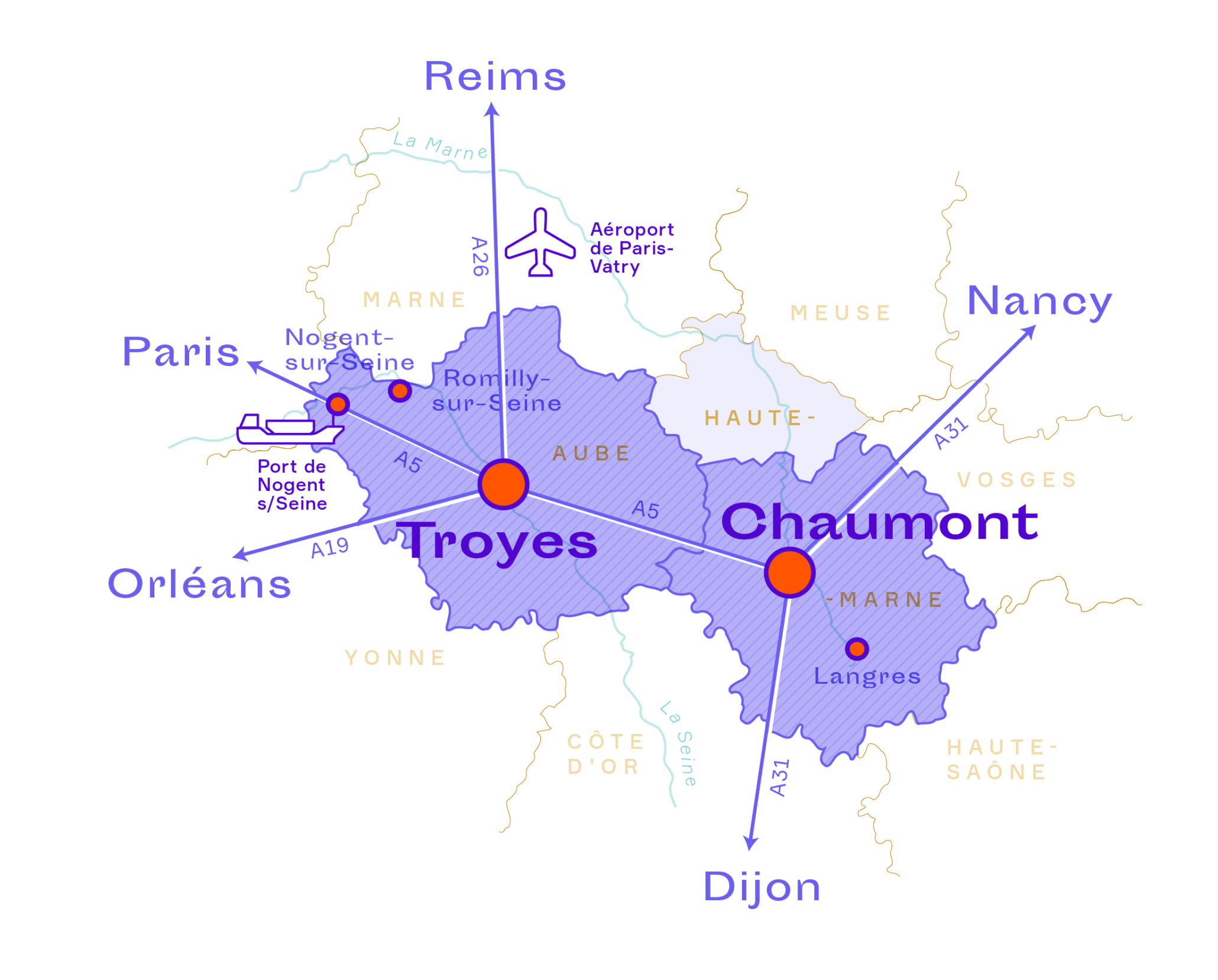
Sud Champagne covers the Aube and Haute-Marne departments, in the Grand Est region. Its main city is Troyes, roughly 150 kilometres south-east of Paris. The economic logic is straightforward: the territory gives access to the Paris market without Paris costs.
Two motorways cross it. The A5 runs from Paris towards Langres, Lyon and the Mediterranean. The A26 connects Calais, the Channel Tunnel and the northern ports to Troyes via Reims. A single site here therefore serves the Paris region, northern France, Belgium and the Netherlands — a configuration most mid-sized French locations cannot offer.
Driving times from Troyes: Paris 1h30 · Lyon 3h30 · Strasbourg 3h30 · Lille 3h30 · Paris-Charles de Gaulle airport around 2h · Nogent-sur-Seine river port 45 min · Paris-Vatry cargo airport 45 min.
Beyond geography, the territory has built genuine industrial specialisations that a cost-driven location cannot replicate:
- Logistics — the Aube Logistics Park covers 250 hectares with more than 600,000 sqm of warehousing and over 1,000 employees, with rail sidings on site. See our page on sectors of excellence.
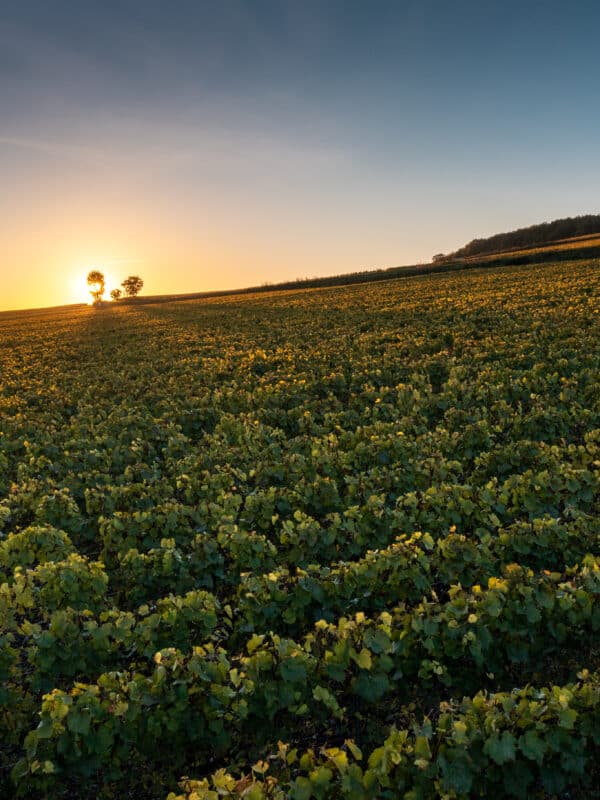
- Bio-economy — the Champagne area is Europe’s leading hemp-producing basin, with a complete chain from farming and decortication through to construction materials, automotive applications and food ingredients.
- Medical devices — the Nogentech cluster, based in Nogent in Haute-Marne, brings together more than fifty industrial companies generating around €500 million in combined turnover. Its Prosthesis Valley branch groups manufacturers of implantable medical devices, built on a long-standing cutlery and precision metalworking tradition.
- Energy — nuclear generation at Nogent-sur-Seine, which produced 18.5 TWh in 2025, alongside wind power and anaerobic digestion.
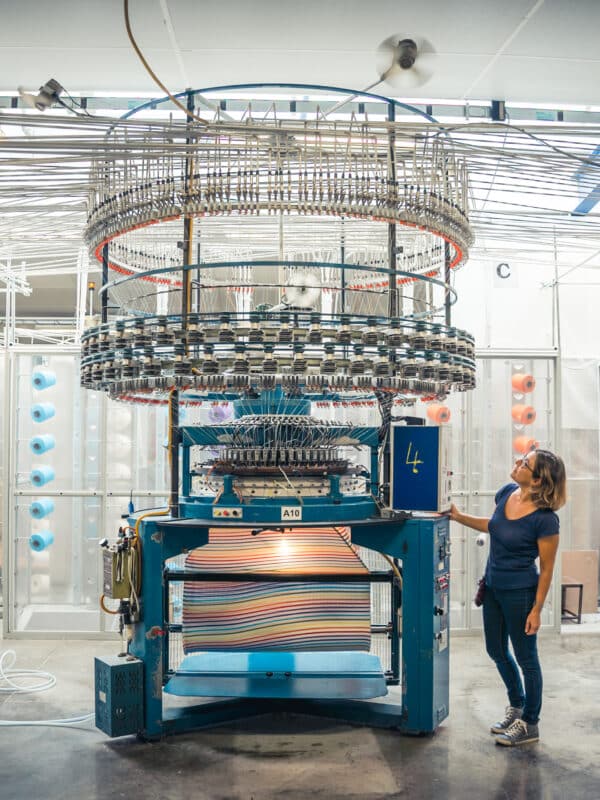
- Textiles and food processing — historic industries with an intact skills base.
3. What it costs: land, buildings, salaries, housing
This is where the gap with the Paris region becomes decisive. All figures below are indicative orders of magnitude in euros, to be confirmed case by case; convert at the current exchange rate for your own budgeting.
| Item | Sud Champagne | Paris region | Ratio |
|---|---|---|---|
| Serviced industrial land | €20 to €60 /sqm | €150 to €300 /sqm | x3 to x5 |
| Industrial building (rent) | €30 to €55 /sqm/year | €80 to €150 /sqm/year | x2 to x3 |
| Warehouse (rent) | €40 to €60 /sqm/year | €70 to €120 /sqm/year | x1.5 to x2 |
| Residential property (purchase) | €2,200 to €2,400 /sqm | around €12,500 /sqm in Paris | around x5 |
| Residential rent | €11 to €12 /sqm | €30 to €40 /sqm in Paris | around x3 |
On a 20,000 sqm warehouse standing on four hectares, the land saving alone runs into several million euros. Over a nine-year commercial lease, the rental differential is of the same order.
One important caveat on interpreting these figures: land typically represents only 10 to 15 % of the total cost of an industrial construction project. The price per square metre is what starts the conversation, but the decisive economics lie in second-order effects — staff housing and retention, inbound and outbound transport, and above all the project timeline.
4. How to set up a business in France: legal forms and registration
Foreign investors generally choose between four structures.
| Structure | Typical use |
|---|---|
| SAS / SASU (simplified joint-stock company) | The most common vehicle for foreign subsidiaries: flexible governance, freely drafted articles, single shareholder possible |
| SARL (limited liability company) | Smaller operations, more rigid statutory framework |
| Branch (succursale) | No separate legal personality; the parent company remains liable |
| Representative office | Market exploration only, no commercial activity |
Since January 2023, all company formalities in France go through a single online portal, the guichet unique operated by the national industrial property institute. Registration covers company creation, modification and cessation, and replaces the former network of separate registration centres.
Practical points that regularly surprise first-time investors:
- A French bank account is needed to deposit the share capital before registration, and opening one for a foreign-owned entity takes longer than most schedules assume.
- Documents issued abroad generally require a sworn translation, and sometimes an apostille.
- There is no minimum capital for an SAS or SARL, but a capital level that is visibly nominal weakens credibility with banks, landlords and public authorities.
- Appointing a local director or legal representative materially speeds up day-to-day administration.
5. Taxation: corporate tax, VAT, local taxes and the R&D credit
Corporate income tax. The standard rate is 25 %. A reduced rate of 15 % applies to the first €42,500 of taxable profit for companies meeting cumulative conditions: turnover of €10 million or less, fully paid-up capital, and at least 75 % of the capital held by individuals. Most foreign-owned subsidiaries do not meet the shareholding condition and are taxed at the standard rate.
VAT. The standard rate is 20 %, with reduced rates for specific goods and services. Intra-EU supplies follow the usual European reverse-charge mechanisms.
Local business taxation. Companies pay a territorial economic contribution, and property tax where applicable. Rates are set locally and vary from one municipality to the next — they must be checked for the specific commune under consideration, never assumed at departmental level. Temporary exemptions on local business or property tax may be granted by local authorities, typically for business creation or expansion.
Research tax credit. This is one of the strongest arguments for locating R&D activity in France. The crédit d’impôt recherche is worth 30 % of eligible R&D expenditure up to €100 million per year, and 5 % above that threshold. It is a tax credit, not a deduction, and is refundable in certain cases. Eligibility rules are precise and documentation requirements are substantial: the scheme rewards companies that organise their evidence from the start.
Please note: French tax rates, thresholds and schemes are reviewed annually in the national budget. The figures above reflect the position for 2026 and should be confirmed with a qualified adviser before any commitment.
6. Incentives available to foreign investors
France does not operate a single national grant for inward investment. Support is assembled from several sources, and the mix depends on the project, its location and the jobs created.
- Regional investment aid from the Grand Est region, targeted at productive investment and job creation.
- Regional aid areas. Part of Haute-Marne is designated under the European regional aid map, which permits investment aid that non-designated areas cannot grant. For an industrial project, the difference between two sites a few dozen kilometres apart can be significant.
- National calls for projects, including those under the France 2030 investment plan, covering industrial decarbonisation, food sovereignty and strategic technologies.
- Bpifrance, the public investment bank, providing loans, guarantees and co-financing.
- Brownfield redevelopment funding for projects reusing previously developed land — an increasingly relevant route given France’s land-artificialisation targets.
- Temporary local tax exemptions, granted at the discretion of local authorities.
One rule overrides all others: aid must be applied for before any firm commitment. A grant requested after signing a deed or starting construction is, as a matter of principle, lost — even where the project would otherwise have qualified. This is the single most expensive mistake foreign investors make in France.
See our page on investing in Sud Champagne.
7. Finding a site: land, buildings and turnkey options
The Aube department alone has more than twenty business parks and over 800 hectares of serviced land. Three routes are available.
- Serviced land and a purpose-built facility. Maximum control over specification; 18 to 24 months to commissioning.
- An existing building. The fastest route — operations can start within weeks — at the cost of adapting to an existing envelope.
- A turnkey site. The developer has pre-completed the studies and procedures (soil survey, archaeology, ecological assessment, planning compatibility), which can bring commissioning below 18 months and substantially reduces risk.
Two technical points deserve early attention, because they constrain schedules more often than land availability does:
Electrical capacity. The presence of a serviced business park does not guarantee that high electrical power is available at a given plot. For an energy-intensive project, network capacity and connection lead times must be investigated at the site-selection stage, not after signing.
Environmental classification. Most industrial and logistics facilities fall under the French classified-installations regime, known by its acronym ICPE. Depending on volumes handled, storage capacities and substances used, a site is subject to declaration, registration or full authorisation. The applicable regime drives the timetable, and the environmental procedure should run in parallel with the building permit rather than after it.
Current availability is listed on our real estate offers page.
8. Hiring, work permits and training
Labour availability. The unemployment rate in the Aube department stood at 9.7 % in the first quarter of 2026, against 7.7 % for the Grand Est region and 7.9 % for metropolitan France (source: Insee, localised unemployment rates). For a public authority this is a figure to bring down; for an incoming employer it means an available labour pool, in a country where many industrial areas are now short of candidates.
Skills base. The area retains a long industrial culture: production and line operation, maintenance, precision machining, logistics and materials handling, textiles, food processing, and materials and surface treatment in the Nogent district. The University of Technology of Troyes trains engineers locally and conducts research in materials, nanotechnology, optics, systems security and data engineering.
Pre-hire training. Publicly funded schemes allow an employer to train candidates to a specific job profile before hiring, with part of the cost covered. These are widely used for industrial and logistics roles and are arranged with the public employment service.
Work permits for international staff. EU, EEA and Swiss nationals need no work permit. For other nationalities, France operates a multi-year residence permit designed for skilled workers, investors, company officers and researchers, generally referred to as the talent passport. It covers the holder’s accompanying family. Categories and thresholds are specific, and applications should be started early — this is frequently the critical path for an expatriate management team.
9. Relocating your people
Persuading managers to move is often harder than finding a site. Two arguments carry weight here.
The first is housing. Residential property in the Troyes area runs at roughly €2,200 to €2,400 per sqm to buy, against around €12,500 per sqm in Paris. A budget that buys a studio flat in the French capital buys a family house with a garden here. Commutes are measured in minutes.
The second is the setting. Troyes has one of France’s largest protected historic centres, with timber-framed medieval streets and some 10,000 sqm of stained glass. The Forêt d’Orient regional nature park, twenty minutes away, covers 346 sq km of forest and lakes. In Haute-Marne, the Forests National Park, created in 2019, is France’s eleventh national park and the first dedicated to lowland deciduous forest. International schooling is limited locally — a point to check early for expatriate families — while Paris remains reachable within ninety minutes.
See our pages on living and working and discover Sud Champagne.
10. Timeline: from decision to first production
- Site selection and shortlisting: 1 to 2 months.
- Company incorporation: a few weeks once the bank account and translated documents are ready.
- Preliminary agreement subject to conditions — planning permission, environmental authorisation, financing.
- Studies, building permit and environmental procedure: 4 to 8 months, run in parallel.
- Construction: 12 to 18 months for a new build; under 18 months in total on a turnkey site; a few weeks only when taking over an existing building.
11. When Sud Champagne is not the right answer
A guide that only argues one way is not useful. This territory is probably the wrong choice if:
- Your model requires daily physical presence in Paris. Ninety minutes supports frequent visits, not permanent attendance.
- You need to recruit large numbers of very scarce specialists — deep-tech researchers, senior regulatory affairs professionals — who are concentrated in a handful of metropolitan areas.
- Your business depends on direct deep-sea port access. The area connects to Le Havre by river, but it is not a port location.
- You are looking for large prime office space, or an international school on the doorstep for expatriate families.
For manufacturing, logistics, processing, applied R&D and back-office operations, the economics are worth testing.
12. FAQ
How do I set up a business in France?
Choose a legal structure — the SAS, a simplified joint-stock company, is the usual vehicle for foreign subsidiaries — then register through the single online portal that has handled all company formalities in France since January 2023. You will need a French bank account to deposit the share capital, and sworn translations of documents issued abroad. There is no minimum capital for an SAS, but a visibly nominal amount weakens credibility with banks and authorities. Appointing a local legal representative materially speeds up day-to-day administration.
What are the incentives for foreign investors in France?
There is no single national grant. Support is assembled from regional investment aid, designated regional aid areas where European rules permit investment subsidies, national calls for projects such as those under France 2030, loans and guarantees from the public investment bank Bpifrance, brownfield redevelopment funding, and temporary local tax exemptions. Separately, the research tax credit is worth 30 % of eligible R&D spending up to €100 million a year. Critically, aid must be applied for before any firm commitment — a grant requested after signing or starting works is in principle lost.
Where can I find industrial land near Paris?
The Aube department, around 90 minutes from Paris, has more than twenty business parks and over 800 hectares of serviced land, at the junction of the A5 and A26 motorways. Serviced industrial land runs at €20 to €60 per sqm, against €150 to €300 per sqm in the Paris region. Large-format logistics buildings are available on the Aube Logistics Park, and turnkey sites with pre-completed studies shorten delivery timescales.
What is the cost of setting up a factory in France?
Land accounts for only 10 to 15 % of the total cost of an industrial construction project. Beyond land at €20 to €60 per sqm in this area, budget for geotechnical and environmental studies, earthworks and internal roads, utility connections — including a dedicated transformer where electrical demand is high — the development tax due when the building permit is filed, legal fees, and the environmental authorisation procedure where applicable. Allow 18 to 24 months from serviced land to commissioning.
Why invest in the Champagne region?
Because it combines proximity to the Paris market with costs three to five times lower on industrial land, four transport modes — motorway, rail, river and air freight — and genuine industrial specialisations: Europe’s leading hemp-producing basin, a medical device cluster of more than fifty companies in Haute-Marne, a large logistics park, and low-carbon electricity generation. The corporate tax rate is 25 %, and the research tax credit covers 30 % of eligible R&D spending.
Considering France for your next site?
Business Sud Champagne is the economic development agency for the Sud Champagne area. We provide current land and property availability, check technical feasibility in advance, connect you with local authorities and developers, and help assemble the funding package. Our service is free and confidential, and we will tell you plainly if the area does not suit your project.
Phone: +33 3 25 73 68 10
Address: 12, rue Bégand – 10000 Troyes, France
Tax rates and thresholds reflect the 2026 position and are reviewed annually; confirm with a qualified adviser before committing. Unemployment data: Insee, localised unemployment rates, first quarter 2026. Prices and availability are indicative and subject to confirmation. Last updated: September 2026.